
There is a strange moment that happens when your beauty shelf gets too full.
You stop knowing what you actually use.
There is the bottle you bought for your hair. The powder someone recommended for your skin. Three unopened packets because they were supposed to be “amazing.” Something sitting at the back that you cannot even remember buying.
And yet, every time you see another herbal ingredient online, you think:
“Maybe I need that one too.”
What if the answer is the opposite?
What if a better herbal routine isn’t about collecting more ingredients, but about understanding a smaller number of them?
Indian households have traditionally used a wide variety of botanicals—from fruits and leaves to roots, flowers, bark and seeds—in personal care and wellness practices. Some of these ingredients are now also being studied for their cosmetic properties, while others remain primarily connected with traditional use.
That makes the idea of an herbal pantry surprisingly relevant today.
Not because one jar can solve everything.
But because a few well-understood ingredients can serve very different purposes.
So let’s try something different.
Forget the giant list of “must-have” powders.
Imagine you’re cleaning out your herbal shelf.
What stays? What goes? And what deserves a second look?
The First Rule: Every Jar Needs a Job
Take everything out of the cupboard.
Now place each ingredient on the table.
Don’t look at the packaging.
Don’t look at the claims.
Just ask one question:
“Why is this here?”
If you cannot answer immediately, that’s your first clue.
An herbal pantry should work more like a toolbox than a collection.
You don’t keep ten screwdrivers because screwdrivers are useful.
You keep the ones you actually need.
The same thinking can completely change the way you approach herbal beauty.
Instead of buying something because it is trending, you choose it because it has a specific role in your routine.
And suddenly, the pantry becomes much smaller.
Pick Your Starting Point: Hair, Skin or Self-Care?
Here’s where it gets interesting.
Two people can have exactly the same collection of herbal powders and use them completely differently.
One person may be interested in traditional hair cleansing.
Another may enjoy preparing occasional face masks.
Someone else may be more interested in traditional wellness ingredients.
So rather than asking:
“Which herbal powder should everyone have?”
ask:
“Which part of my routine am I trying to simplify?”
That one question changes everything.
If Hair Is Your Starting Point…
Your first instinct might be to buy a dozen hair powders.
Don’t.
Start by separating cleansing from conditioning and masking.
They are not the same thing.
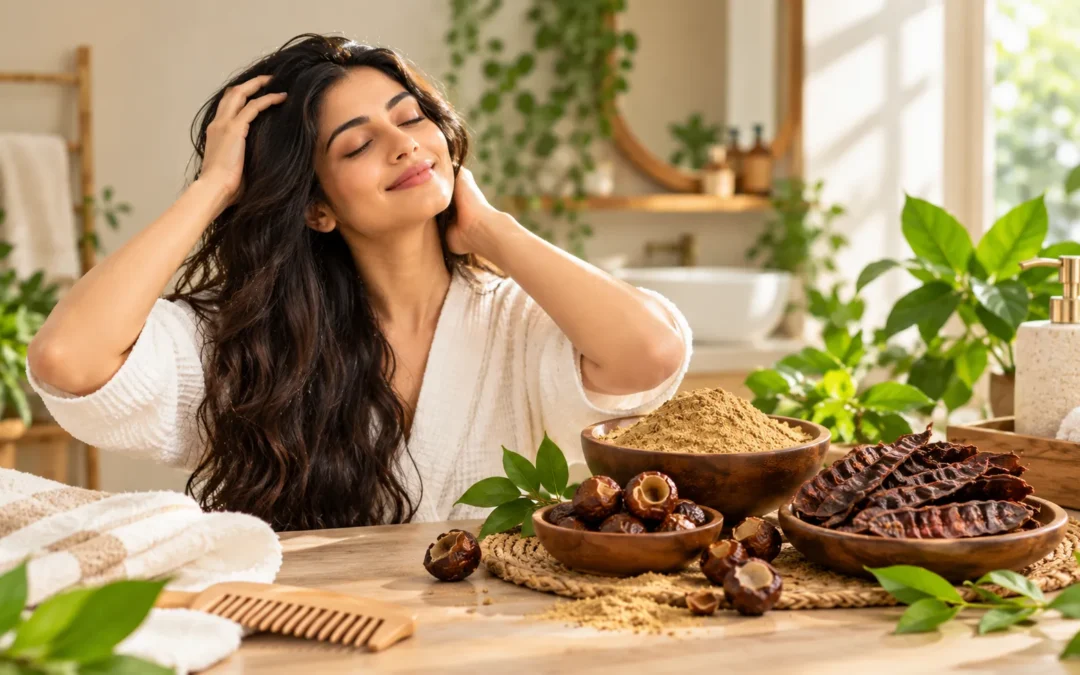
Some traditional Indian hair-care ingredients contain naturally occurring compounds such as saponins, which help explain their historical use in cleansing preparations. Reetha and shikakai are notable examples.
That gives the traditional routine an interesting scientific angle.
But the bigger lesson is simpler:
Your hair doesn’t need every ingredient at the same time.
The “old-school cleanser” shelf
Reetha powder is traditionally associated with soapnut fruit and its naturally occurring saponins.
Shikakai powder comes from Acacia concinna and has traditionally been used in hair-cleansing preparations.
The experience can be very different from using a modern bottled shampoo.
And that is precisely why people experimenting with traditional hair care often find it interesting.
You’re not simply replacing one commercial product with another.
You’re changing the way you think about cleansing.
Then Ask: What Kind of Hair Routine Do I Actually Enjoy?
Maybe you’re someone who enjoys a longer weekend hair ritual.
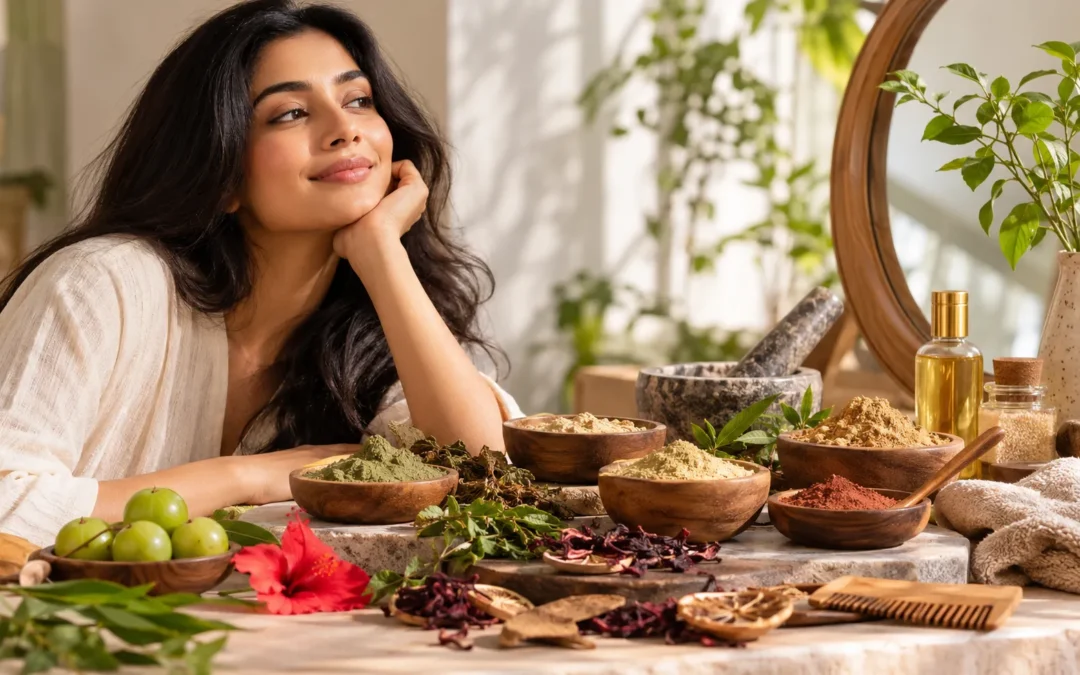
That’s where ingredients such as amla powder, brahmi powder, hibiscus powder and curry leaves powder enter the conversation.
These botanicals have longstanding associations with Indian hair-care traditions.
But don’t turn your bathroom into a mixing station just because you own them.
Choose based on the ritual you actually enjoy.
If you hate spending 45 minutes preparing a hair mask, a complicated recipe won’t magically become sustainable because it contains eight “natural” ingredients.
The best routine is often the one you will actually repeat.
The “One New Ingredient” Experiment
Here’s a better way to explore your pantry.
Don’t introduce five ingredients on the same weekend.
Choose one.
Use it as intended.
Pay attention.
Then decide whether it deserves a permanent place.
This approach has another advantage: you can actually learn something from the experience.
If you change five things simultaneously and your hair feels different, what caused it?
You won’t know.
If you change one thing, your observations become much more useful.
This isn’t about turning your beauty routine into a scientific experiment.
It’s simply about avoiding unnecessary confusion.
Now Look at Your Face-Mask Shelf
Here’s where you should stop thinking about hair completely.
Facial skin has its own needs and sensitivities.
An ingredient being traditional or plant-based doesn’t automatically make it appropriate for every skin type.
That matters because botanical ingredients can still cause irritation or allergic reactions. “Natural” is not a guarantee of safety.
So instead of asking:
“What can I put on my face?”
ask:
“What kind of preparation am I trying to make?”
That is a much safer starting point.
The Bowl Test
Imagine you’re making a traditional face mask.
You have a bowl.
You have water.
You have a few powders.
Now resist the temptation to throw everything in.
This is where multani mitti becomes interesting.
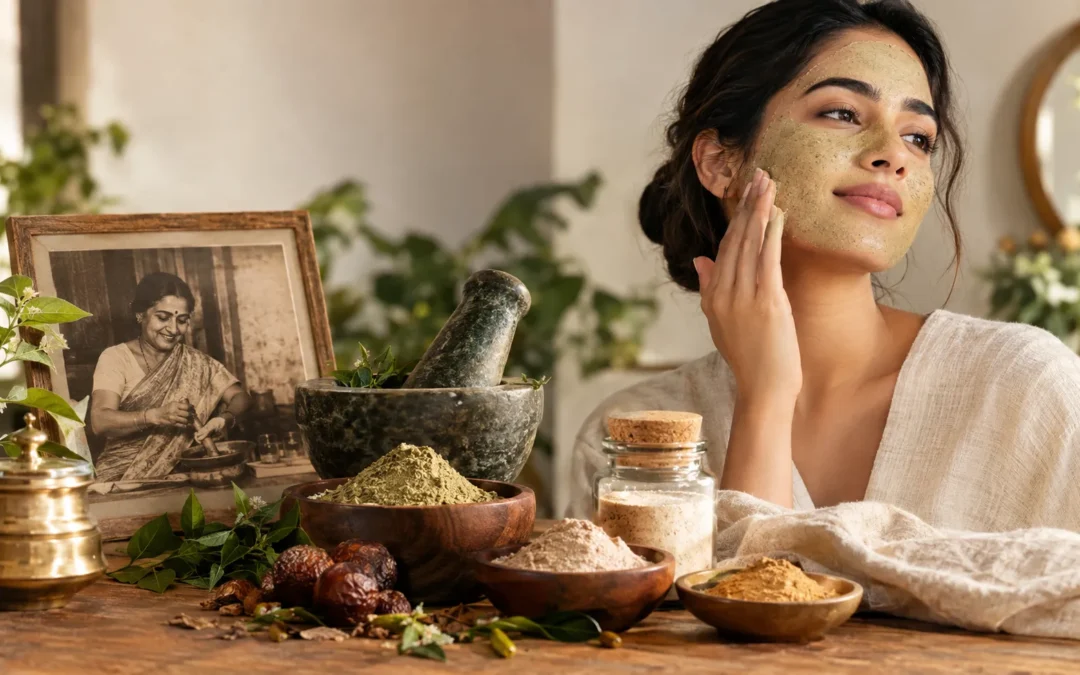
It has a familiar place in traditional Indian face-mask routines and is often associated with simple clay-based preparations.
Then there is ubtan powder, which represents an entirely different idea: instead of relying on a single hero ingredient, traditional ubtan-style preparations can combine several botanical materials into one ritual.
And suddenly you see the difference between two approaches.
Modern beauty often asks:
“Which active should I use?”
Traditional preparation often asks:
“What should I make?”
Neither question is automatically better.
They’re simply different ways of approaching personal care.
Your Kitchen May Already Be Part of the Story
Open the kitchen cupboard.
You may find ingredients that have crossed between food and traditional beauty practices for generations.
The obvious example is turmeric powder.
Turmeric has been widely studied because of compounds such as curcumin, including research into potential dermatological applications. However, evidence for a specific cosmetic result depends on the preparation, concentration and method of use.
That distinction is important.
A plant can have interesting chemistry.
It can have a long traditional history.
And yet, that doesn’t mean every claim attached to it online has been scientifically established.
Good herbal beauty doesn’t require exaggerated claims.
The real story is already interesting enough.
Then You Find the Unexpected Ingredients
At the back of the shelf are the ingredients you bought because they sounded intriguing.
Moringa powder is one example.
Moringa has attracted interest in nutritional, traditional and cosmetic research because of its wide range of naturally occurring plant compounds.
Then there is aloe vera powder, connected to one of the most familiar botanical names in modern skincare.
Beetroot powder brings another plant-based ingredient into the conversation, particularly because of its distinctive pigments and phytochemical content.
The mistake would be treating all three as interchangeable.
They’re not.
Different plants.
Different compositions.
Different traditional uses.
That’s why a herbal pantry becomes more useful when you understand the identity of the ingredient, rather than simply recognising the word “herbal.”
The Shelf You Shouldn’t Turn Into a DIY Laboratory
This is the part that deserves more attention.
You see a recipe online.
It contains three ingredients.
Then another creator adds two more.
Someone suggests lemon.
Someone else adds oil.
Another person says to leave it overnight.
Suddenly your simple face mask has become a chemistry project.
Stop.
You don’t get bonus points for using ten ingredients.
In fact, the more ingredients you combine, the harder it becomes to understand what your skin or hair is reacting to.
A simpler routine is easier to monitor.
And if you’re trying something new, that matters.
What About Neem, Mulethi and Manjistha?
This is where a pantry starts to feel less like a beauty cabinet and more like a piece of Indian herbal history.
Neem powder has a long association with traditional Indian household and personal-care practices.
Mulethi powder, derived from licorice, has its own extensive history in traditional practices and has also been investigated for cosmetic applications.
Manjistha powder is another botanical associated with traditional Indian herbal preparations.
But these ingredients shouldn’t all be thrown into the same category.
Their traditional roles are different.
Their chemical compositions are different.
And their suitability for a particular application can be different.
The word “herbal” tells you where an ingredient comes from.
It doesn’t tell you exactly how you should use it.
Not Everything in the Pantry Belongs in the Bathroom
Now comes an important distinction.
Some ingredients are associated primarily with traditional wellness rather than everyday cosmetic use.
Take ashwagandha powder.
It has a long history within Ayurveda and traditional wellness practices, but that doesn’t mean it should automatically be treated like a face-mask ingredient.
The same principle applies to arjun chaal powder and bael leaf powder.
They have their own traditional contexts.
They don’t need to be forced into a beauty routine just because they’re available in powder form.
This is one of the biggest advantages of actually understanding your ingredients:
You learn when not to use something.
The “Keep, Question, Remove” Method
Now imagine you’re standing in front of your pantry again.
Instead of organising everything alphabetically, create three imaginary sections.
KEEP
Ingredients you understand, use and genuinely enjoy.
QUESTION
Ingredients you bought because of a trend but haven’t really found a purpose for.
REMOVE
Ingredients that are expired, poorly stored, incorrectly labelled or simply unsuitable for the way you intended to use them.
This tiny exercise can completely change your relationship with your herbal shelf.
Suddenly, you don’t need another shopping list.
You need a better system.
What About the Ingredients You Rarely Hear About?
A good herbal pantry doesn’t have to be made only from viral ingredients.
Some botanicals are interesting precisely because they aren’t constantly appearing in social media routines.
Jatamansi powder has a long association with traditional Indian herbal practices.
Nagarmotha powder is another traditional botanical with its own history and applications.
Katha powder and catechu represent yet another category of traditional plant-derived material.
Then there is methi powder, familiar from the kitchen but also associated with traditional personal-care practices.
And indigo powder has an especially distinctive place in traditional hair-colouring practices.
The lesson isn’t that you need all of them.
It’s that there is a much bigger herbal world beyond the five ingredients that happen to be trending this week.
Your Pantry Doesn’t Need to Be Perfect
Here’s something people often forget about traditional routines.
They were never necessarily designed to look perfect on Instagram.
The bowl might be messy.
The mixture might not look beautiful.
The preparation might take longer than opening a bottle.
And that’s okay.
The value of a traditional routine isn’t measured by how aesthetic the jar looks on a bathroom shelf.
It is measured by whether the ingredient makes sense for you and whether you can use it comfortably and consistently.
A Better Way to Think About “Wellness”
Wellness has become a huge umbrella.
Everything gets placed underneath it.
Hair.
Skin.
Food.
Sleep.
Stress.
Supplements.
Beauty.
But these are not interchangeable categories.
An ingredient being traditionally associated with wellness doesn’t automatically make it suitable for topical use.
And something that works as a cosmetic ingredient isn’t automatically something you should consume.
That is why your herbal pantry should have boundaries.
Hair care is one category.
Skincare is another.
Wellness is another.
They can exist on the same shelf without becoming the same thing.
The Pantry Challenge
Now imagine you have one small drawer.
You can only keep six ingredients.
That’s it.
No cheating.
No seventh jar.
What would you choose?
You might choose ingredients for cleansing.
You might choose something for occasional hair care.
You might choose something that fits your face-mask routine.
You might choose a traditional wellness ingredient.
But your choices would immediately become more thoughtful.
Because when space is limited, every ingredient needs a reason.
And that is exactly what a good herbal pantry should teach us.
The Beauty Routine Becomes Smaller—and Smarter
Once you stop chasing every new ingredient, something interesting happens.
You start recognising repetition.
You realise that you bought three products that essentially serve the same purpose.
You notice that some powders have been sitting untouched for months.
You stop asking which ingredient is “powerful” and start asking which ingredient is appropriate.
That is a much more useful question.
And it can lead to a beauty routine that is simpler without becoming careless.
There Is No Universal Herbal Pantry
Your ideal pantry might look completely different from someone else’s.
Someone with a traditional hair-care routine may prioritise cleansing and mask ingredients.
Someone who enjoys occasional DIY skincare may prefer clay and botanical preparations.
Someone interested primarily in traditional wellness may have a completely different collection.
There isn’t one correct shelf.
And there doesn’t need to be.
The point is to make the shelf make sense for you.
Before You Add Another Jar…
Next time an herbal ingredient starts trending, don’t immediately search for where to buy it.
Pause.
Ask:
Do I know what it is?
Do I know what role it plays?
Do I already own something similar?
Is the product intended for the use I’m considering?
Will I realistically use it?
Five questions.
Ten seconds.
Potentially a much less crowded cupboard.
The Real Beauty of an Herbal Pantry
Perhaps the most valuable thing about an herbal pantry isn’t the powders themselves.
It’s the mindset behind them.
You begin paying attention to ingredients.
You stop expecting one product to solve everything.
You become more selective about what enters your routine.
And you start seeing beauty as something you can understand rather than endlessly purchase.
That doesn’t mean modern products have no place.
They absolutely do.
A well-formulated cosmetic product can offer consistency, convenience, preservation and carefully controlled concentrations that are difficult to recreate at home.
Traditional botanicals offer something different: history, familiarity, ritual and a connection to plant-based practices that have existed for generations.
You don’t have to choose one world and reject the other.
So, Could One Herbal Pantry Really Cover Hair, Skin and Wellness?
Not by making every ingredient do everything.
That would defeat the entire point.
A genuinely useful herbal pantry works because each ingredient has a defined place.
Some belong to hair care.
Some belong to skincare.
Some belong to traditional wellness.
Some are occasional ingredients.
And some probably don’t need to be there at all.
The smartest pantry isn’t the one overflowing with powders.
It is the one where you can pick up any jar and answer one simple question:
“Why do I have this?”
If you can answer that, you’re no longer just collecting herbal ingredients.
You’re building a routine.
And perhaps that is the real upgrade modern beauty could borrow from traditional herbal care:
Less chasing. Less clutter. More understanding.