
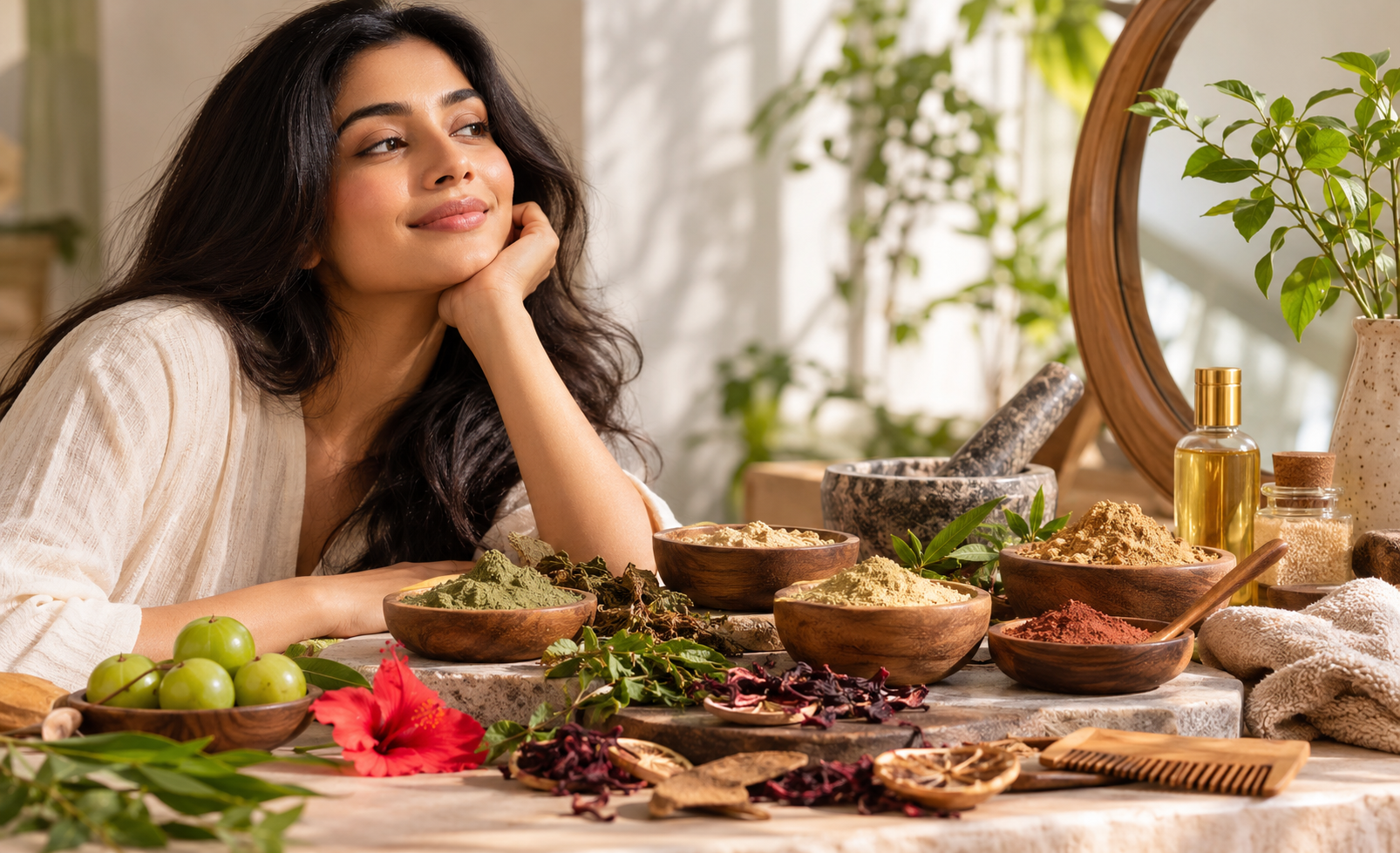
What if your beauty routine became less about reaching for another bottle and more about understanding the ingredients sitting on your shelf?
For 30 days, imagine stepping away from complicated routines and exploring traditional Indian botanical powders instead. Not as a challenge to prove that one approach is better than another, but as an opportunity to slow down, experiment thoughtfully, and rediscover ingredients that have been part of Indian beauty traditions for generations.
From hair cleansing and masks to clay-based skincare and traditional colour rituals, these simple powders can serve very different purposes.
The key is knowing which ingredient belongs where, how it is traditionally used, and how it can fit into a routine that works for you.
So, what might 30 days teach you?
Let’s find out.
Week 1: Start With Your Hair
The easiest place to begin is often the part of your routine you already know well: hair care.
Instead of changing everything at once, start with one ingredient and give yourself time to understand the experience.
Days 1–2: Meet a Traditional Hair-Care Favourite
Amla powder has a long history in traditional Indian hair-care practices. It is commonly incorporated into homemade hair masks and other botanical preparations.
What makes it interesting isn’t the idea of a miracle transformation. It is the simplicity.
You can work with one recognizable botanical ingredient, prepare it according to the intended use, and observe how it fits into your routine.
During these first two days, notice the basics:
How does your hair feel?
How easy is the preparation?
Do you enjoy the ritual enough to repeat it?
Those questions are more useful than chasing instant results.
Days 3–4: Rethink the Way You Cleanse
Traditional hair care isn’t only about masks and oils. Cleansing can also look very different.
Reetha powder has traditionally been associated with botanical hair-cleansing practices. It can be prepared according to the product’s directions and incorporated into a hair-washing routine.
Unlike conventional shampoo, the preparation and application can become part of the experience itself.
You may need to adjust how you apply it.
You may need to spend more time rinsing.
And you may discover that your hair responds differently than expected.
That’s perfectly fine.
The purpose of the experiment is not to force a replacement. It is to understand another approach to cleansing.
Days 5–6: Add a Second Hair Ritual
Once you’ve explored cleansing, you can introduce another traditional ingredient.
Brahmi powder is traditionally incorporated into Indian hair-care preparations and can be mixed into a paste or used as part of a hair mask.
This is where the routine starts becoming more personal.
Perhaps you prefer a simple preparation that takes ten minutes. Perhaps you enjoy taking more time over a weekend ritual.
You can also explore curry leaves powder for hair, an ingredient that brings a familiar Indian botanical into homemade hair-care preparations.
And then there is bhringraj powder, another ingredient traditionally associated with Indian hair-care rituals and often explored in homemade preparations.
You don’t need all three.
The point is to discover which rituals actually fit your lifestyle.
Week 2: Bring the Experiment to Your Skin
By the second week, move slowly from hair care towards skincare.
Your skin has different needs from your hair, so this is the stage where being selective becomes especially important.
One new ingredient at a time is a much more useful approach than mixing everything together.
Days 7–8: Rediscover the Face Mask
Ubtan powder represents one of India’s best-known traditional beauty rituals.
Rather than being one universal formula, ubtan can describe different combinations of botanical and kitchen ingredients prepared as a paste.
That flexibility is part of its appeal.
The preparation can be simple.
The texture can be adjusted.
And the ritual can become a mindful part of your skincare routine.
But don’t assume that adding more ingredients will automatically make the preparation better. Your skin’s tolerance should always come first.
Day 9: A Citrus-Inspired Experiment
Lemon peel powder can be incorporated into certain traditional-style face preparations.
This is also a good point in the challenge to remember that natural doesn’t automatically mean gentle.
Citrus-derived ingredients may be irritating for some people, particularly when used directly on the skin.
If you’re trying a new preparation, patch testing is a sensible first step.
And remember: a beauty experiment should leave you curious, not uncomfortable.
Days 10–11: Explore Botanical Skincare
Neem powder has a long association with traditional Indian skincare and cleansing practices.
It can be explored in simple face-mask preparations, but there is no need to turn it into an everyday ritual simply because it is traditionally popular.
Another ingredient to discover is manjistha powder, which has also been used in traditional Indian beauty preparations.
The interesting thing about these ingredients is the way they change how you think about skincare.
Instead of asking, “Which new product should I buy?”
You start asking:
“What ingredient am I using?”
“Why is it traditionally used?”
“Does it actually fit my routine?”
That shift in thinking may be one of the most valuable parts of the 30-day experiment.
Days 12–13: Get to Know Clay
Few traditional skincare ingredients are as recognizable as multani mitti.
Its clay-like texture makes it particularly associated with face masks and cleansing rituals. Mixed into a paste, it creates a very different experience from the creams and gels commonly found in modern skincare routines.
But clay-based preparations aren’t necessarily for everyday use.
If your skin feels dry or tight afterward, take that as useful feedback.
Your routine should adapt to your skin—not the other way around.
Day 14: A Traditional Botanical With a Distinctive Colour
Red sandalwood powder brings another traditional botanical into the skincare experiment.
Its naturally rich colour makes it visually distinctive, while its history in Indian beauty preparations adds another layer to the ritual.
If you’re exploring traditional ingredients, focus on the preparation and your own skin’s response rather than expecting guaranteed cosmetic results.
By the end of week two, you may realize something important:
A simpler shelf can still offer plenty of ways to experiment.
Week 3: Turn Ingredients Into Rituals
By now, the novelty begins to fade.
That’s actually a good sign.
You’re no longer trying something new simply because it’s new.
You’re starting to build a routine.
Instead of asking, “What can I use today?” you might start asking:
- What does my hair need?
- What feels comfortable on my scalp?
- Does my skin feel balanced?
- Which preparation is easy enough to repeat?
- Which ingredients do I actually enjoy?
- Which ones can I leave behind?
That’s when a beauty experiment becomes genuinely useful.
Days 15–16: Bring Hibiscus Into Hair Care
Hibiscus powder for hair is traditionally explored in homemade hair-care preparations and masks.
It can be mixed into a paste and incorporated into a simple hair ritual depending on the desired preparation.
The important thing isn’t creating a complicated recipe with ten different ingredients.
It’s consistency.
A simple preparation that you genuinely enjoy using once a week is far more realistic than an elaborate ritual you abandon after two attempts.
Day 17: A Little Yellow Goes a Long Way
Turmeric powder for face can be explored as part of traditional Indian skincare and beauty rituals.
Turmeric has a strong cultural connection with Indian ceremonies and traditional preparations, and its intense colour means that even a small amount can make a noticeable difference to the appearance of a DIY mixture.
There is one practical consideration: staining.
Skin, clothes, towels, countertops—turmeric can leave its mark.
So prepare accordingly.
Day 18: Discover Something Less Familiar
Nagarmotha powder may not be as familiar as some of the other ingredients on this list.
And that’s exactly what makes it interesting.
A traditional botanical shelf introduces you to plants and ingredients that might never appear in a conventional beauty-shopping trip.
You aren’t simply following the latest trending product.
You’re learning about individual ingredients and the traditions surrounding them.
Not every ingredient needs to become a permanent part of your routine.
Sometimes discovering something new is enough.
Days 19–20: When the Kitchen Meets Beauty
Methi powder is another ingredient that demonstrates how closely food traditions and beauty traditions can sometimes overlap in Indian culture.
It is traditionally associated with homemade hair-care preparations and can be explored as part of a botanical hair ritual.
But there is an important distinction to remember:
An ingredient being familiar as food doesn’t automatically mean that every form or preparation is appropriate for topical use.
Always consider the intended use of the specific product.
Day 21: Enter the World of Natural Hair Colour
Indigo powder takes the experiment in a completely different direction.
Rather than simply being part of a hair mask or cleansing ritual, indigo has a long history as a natural dye and is particularly relevant to traditional hair-colouring practices.
This type of preparation requires more patience.
Timing matters.
Application matters.
And the result can depend on your starting hair colour and the way the preparation is used.
If you’re experimenting for the first time, a small strand test is a much better place to start than an important event.
Week 4: Make the Routine Your Own
By the final week, you may notice something unexpected.
You’re no longer interested in using every powder.
Instead, you’re beginning to choose.
That’s probably the most realistic result of the challenge.
A successful beauty routine doesn’t have to contain dozens of ingredients.
It needs ingredients and rituals that make sense for you.
Day 22: Explore a Traditional Root Ingredient
Ashwagandha powder is widely recognized in Indian traditional wellness practices and may also appear in certain beauty preparations.
If you’re considering it for topical use, remember that traditional use and scientifically established cosmetic effects are not the same thing.
The goal of this experiment is to explore beauty rituals thoughtfully—not to treat a botanical ingredient as a substitute for professional medical advice or treatment
Day 23: A Different Way to Use Aloe
If you’re accustomed to fresh aloe gel, aloe vera powder offers a completely different format.
The powdered form can be convenient to store and allows you to prepare smaller quantities when needed.
But don’t assume every powder works in exactly the same way.
Always follow the preparation instructions provided with the specific product.
Day 24: Discover a Traditional Bark Ingredient
Arjun chaal powder introduces another example of the enormous botanical diversity found in traditional Indian practices.
It may not be an ingredient you immediately associate with a modern beauty shelf.
But that’s part of the appeal of this experiment.
You’re moving beyond finished products and learning about individual botanical ingredients and their traditional contexts.
Day 25: Add a Splash of Colour
Beetroot powder brings natural colour into the experiment.
Its strong pigmentation makes it particularly interesting for DIY beauty preparations, although staining should always be considered when preparing and applying colourful botanical mixtures.
Not every ingredient has to become a permanent part of your routine.
Some are simply enjoyable to discover.
Day 26: One More Botanical Discovery
Bael leaf powder adds another example of the diversity found across traditional Indian botanical practices.
At this stage, your shelf may look very different from day one.
But the biggest change isn’t the number of jars.
It’s your understanding of them.
You know which ingredients interest you.
You know which preparations are practical.
And, perhaps most importantly, you’re becoming less likely to mix several unfamiliar ingredients together simply because you saw a viral DIY recipe.
What About Different Names for Traditional Ingredients?
When exploring Indian botanical ingredients, you may sometimes find different names used for related preparations.
This can make online research confusing, particularly when comparing products or reading traditional beauty recipes.
Rather than focusing on every variation, concentrate on understanding the actual ingredient, its intended use, and the preparation instructions supplied with the product.
That keeps your routine simple and your research much easier to navigate.
What Could 30 Days Actually Teach You?
After a month, the biggest change may not be a dramatic transformation in your hair or skin.
It may be that you’ve become more selective.
You may discover that you enjoy preparing a simple hair mask once a week.
You may realize that a particular clay-based preparation doesn’t suit your skin.
You may find one botanical ingredient that becomes a favourite.
Or you may decide that traditional powders are fascinating but that you still prefer your regular shampoo, cleanser, or moisturizer.
All of those are perfectly reasonable outcomes.
The goal isn’t to prove that traditional ingredients are automatically better than modern beauty products.
The goal is to understand what you’re using, simplify where possible, and make more intentional choices.
Your 30-Day Traditional Powder Challenge
Want to try it yourself?
Don’t start by putting every powder into one bowl.
Build your routine gradually.
Week 1: Hair
Choose one cleansing or hair-care ingredient and observe how your hair responds.
Week 2: Skin
Introduce one skincare preparation at a time.
Week 3: Explore
Try another botanical ingredient rather than changing your entire routine at once.
Week 4: Simplify
Keep the ingredients and rituals you genuinely enjoy.
By the end of the month, your beauty shelf may actually contain fewer products, not more.
And that might be the most interesting result of all.
A Few Rules Before You Start
Traditional doesn’t automatically mean risk-free.
Natural ingredients can still cause irritation, allergic reactions, dryness, staining, or sensitivity.
Before introducing something new:
- Patch test first, particularly when using it on your face or scalp.
- Avoid applying unfamiliar ingredients to broken or irritated skin.
- Don’t combine several new ingredients during your first trial.
- Follow the preparation instructions supplied with the product.
- Stop using an ingredient if you develop irritation or discomfort.
- Be especially careful around the eyes and other sensitive areas.
- Don’t assume that an ingredient traditionally used as food is automatically suitable for topical application.
- If you have an allergy, skin condition, or ongoing treatment, speak with a qualified healthcare professional before experimenting.
The smartest 30-day challenge is one where you pay attention to your skin and hair rather than chasing dramatic before-and-after results.
So, Would You Replace Your Beauty Shelf?
Maybe not completely.
And that’s the point.
Traditional Indian powders don’t have to replace every modern beauty product you own. They can simply introduce another way of thinking about personal care: fewer ingredients, more awareness, and a closer connection to traditional beauty rituals.
A jar of powder may look simple.
But behind it can be a plant, a preparation method, a cultural tradition, and generations of beauty practices.
After 30 days, you might find yourself reaching for fewer products, reading ingredient labels more carefully, and thinking twice before adding another trending product to your shelf.
The real transformation may not be what happens to your skin or hair. It may be what happens to the way you choose your beauty routine.